
In the world of writing, words that sound the same but have different meanings can be tricky. Two such words are “feal” and “feel.” Although they sound similar, they aren’t interchangeable. This article will explain the differences between “feal” and “feel,” helping you use the right word in the right context. By understanding these distinctions, you can improve your writing and avoid common errors. Let’s dive into the details of “feal vs feel” to clear up any confusion.
The term “feal” emerged in the 1560s, deriving from the Old French “feal”, which meant “faithful, loyal, true, sincere”. This word was a variant of “feeil”, originating from the Latin “fidelis”, meaning “loyal”. While not present in Middle English, “feal” gained usage in the context of describing loyalty and faithfulness, particularly in relationships and allegiances.
Feal (v.)
As a verb, “feal” means “to hide” or “to conceal”. It originated in the early 14th century in Northern English and the Northern Midlands, borrowed from the Old Norse word “fela”, which also means “to hide”.
What Does the Word “Feel” Mean?
The word “feel” is a verb that means to perceive or experience something through the senses or emotions. It can refer to both physical sensations and emotional states. “Feel” is a commonly used word in English and has a wide range of applications, from describing touch to expressing emotional experiences.
You will like: Artist vs Artisan: What’s the Difference?
Origins of the Word “Feel”
The word “feel” originates from Old English “felan”, meaning “to touch or have a sensory experience of; perceive, sense”. By the late Old English period, it also meant “to have a mental perception.” It comes from the Proto-Germanic “*foljanan”, which is also the source of similar words in other Germanic languages, such as Old Saxon “gifolian”, Old High German “vuolen”, and German “fühlen”, all meaning “to feel”. The evolution of the term in Germanic languages often expanded from physical touch to emotional perception.
Feel (n.)
As a noun, “feel” refers to the sensation or impression that something gives you, either through touch or through a general sense of perception. It can also describe the overall atmosphere or mood of a situation.
This use of “feel” developed from the Old English verb “felan”, meaning “to touch or perceive”, evolving to include the idea of a tangible sensation or impression in the 16th century.
“Feal” vs “Feel”: The Differences
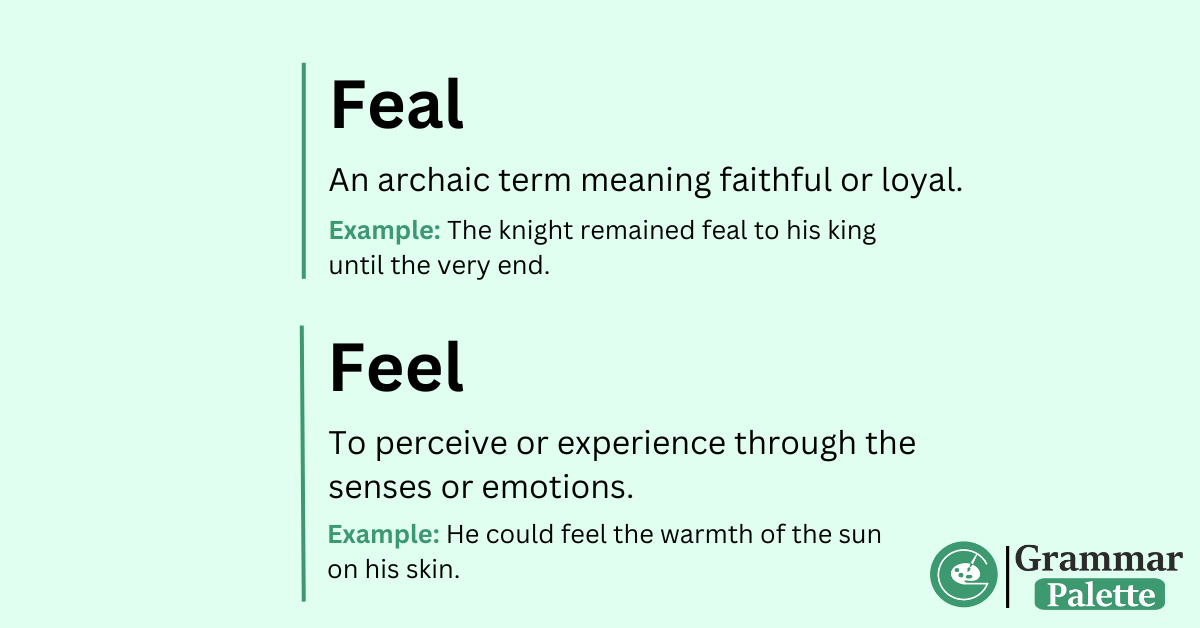
Sounding the same but differing in meaning and usage, feal and feel are homophones. “Feal” is an old term meaning faithful or loyal, primarily found in historical texts and not commonly used today. “Feel,” on the other hand, is a modern verb that means to perceive through the senses or to experience emotions. For example, “feal” could describe a person’s loyalty to a friend, while “feel” describes the sensation of warmth or the emotion of happiness. Understanding these differences can aid in interpreting historical literature and using precise language in contemporary contexts.
| Aspect | Feal | Feel |
|---|---|---|
| Meaning | An old term meaning faithful or loyal. | A modern verb meaning to perceive through the senses or to experience emotions. |
| Usage | Primarily found in historical texts. | Commonly used in everyday language. |
| Example | “The knight remained feal to his lord.” | “She could feel the warmth of the sun.” |
| Origins | Old French “feal,” from Latin “fidelis” | Old English “felan,” from Proto-Germanic “foljanan” |
| Context | Historical and poetic contexts. | Everyday speech and writing. |