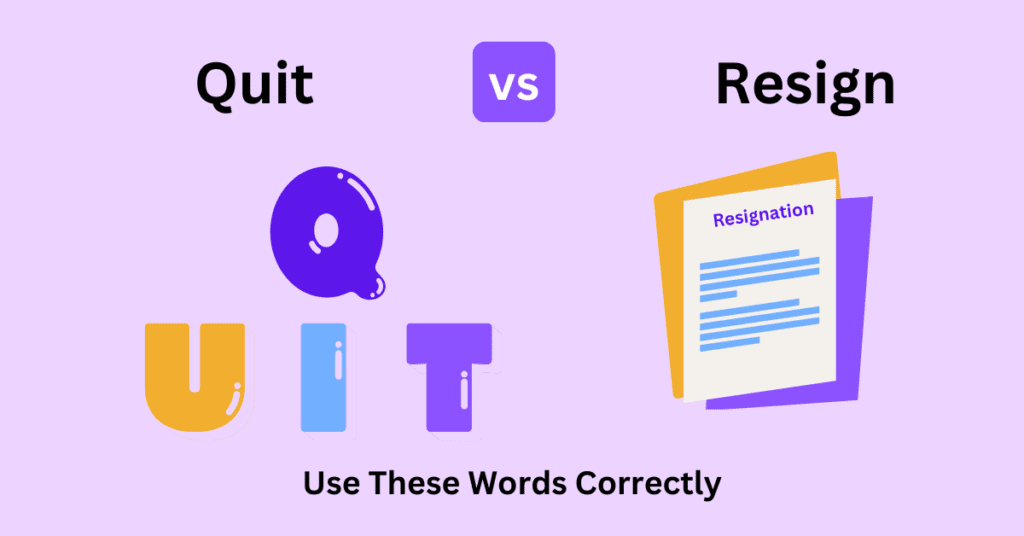
When it comes to leaving a job, the terms “quit” and “resign” are often used interchangeably, but they carry distinct connotations. Understanding the difference between “quit” and “resign” is essential for using these words appropriately in both casual and professional settings. While both imply ending employment, they can reflect different circumstances, levels of formality, and impacts on your professional image. In this article, we’ll explore “quit vs resign”, ensuring you know when and how to use each correctly.
Why Is There Confusion?
The confusion between “quit” and “resign” often arises because both words describe the act of leaving a job. However, the difference lies in their tone, context, and formality. “Quit” is commonly associated with a sudden or informal departure, often without prior notice. On the other hand, “resign” is viewed as a more formal and professional term, typically involving a resignation letter and notice period.
This overlap in meaning, combined with the casual interchangeability of the terms in everyday language, leads to misunderstandings about when each word is appropriate.
⚡ Quick Summary
“Quit” and “Resign” both involve leaving a position, but their usage varies. “Quit” is informal and often used for abrupt or casual exits, typically in personal contexts. On the other hand, “Resign” is a formal term, used in professional settings to describe a deliberate and respectful departure, often accompanied by notice. While “Quit” implies immediacy, “Resign” reflects a more structured and polite process.
When to Use “Quit”?
The term “quit” is often used to describe leaving a job or situation abruptly or informally. It conveys a sense of immediacy and is commonly associated with personal decisions made without much formality. Here are some scenarios where “quit” is appropriate:
- Informal Situations: “Quit” is more suitable for casual conversations or informal contexts. For example, “I decided to quit my part-time job last week.”
- Sudden or Voluntary Action: The word implies that the decision to leave was made independently, often without prior notice. For instance, “She quit because she couldn’t handle the stress anymore.”
- Broader Applications: While “quit” is often job-related, it can also apply to other actions, such as giving up habits or activities. For example, “He quit smoking last year.”
Must Read: Than vs Then: Avoiding Common Mistakes in English
When to Use “Resign”?
The term “resign” (not re-sign) is typically used in formal and professional contexts when someone voluntarily leaves a position, especially in the workplace. It carries a sense of decorum and is often accompanied by proper procedures, such as submitting a resignation letter. Here’s when “resign” is the better choice:
-
- Professional Contexts: Use “resign” when referring to leaving a job in a respectful and formal manner. For example, “She decided to resign from her position as manager.”
- Notice Period: The word often implies that the individual has followed the protocol of giving a notice period before departing. For instance, “He resigned last month and gave two weeks’ notice.”
- High-Profile or Official Roles: When public figures or executives leave their roles, “resign” is the appropriate term. For example, “The CEO announced his decision to resign during the board meeting.”
A Quick Tip:
- Quit: Informal, sudden action.
- Examples: I quit my job yesterday.
- He quit smoking last year.
- Resign: Formal, polite, deliberate.
- Examples: “She resigned as manager.
- He gave two weeks’ notice before resigning.
“Quit” and “Resign”: (As Verbs)
Usage of “Quit” as a Verb
The verb “quit” is versatile and can be used in several contexts. Here’s a breakdown of its grammatical usage:
- To Stop or Cease Doing Something
- “Quit” is often used to indicate stopping an action or behavior.
- Example: She decided to quit smoking.
- To Leave a Place or Situation
- It can mean to leave a job, place, or situation.
- Example: He quit the meeting early due to an emergency.
- To Abandon or Give Up
- “Quit” also conveys the idea of abandoning or giving up on something.
- Example: They quit the project halfway through.
- Form and Tense
- The verb “quit” is irregular. Its past and past participle forms are the same as the base form (quit).
- Present: I quit.
- Past: She quit her job last month.
- Past Participle: They have quit their bad habits.
- The verb “quit” is irregular. Its past and past participle forms are the same as the base form (quit).
- Common Phrases
- “Quit it”: Used informally to tell someone to stop doing something annoying.
- Example: Quit it! That noise is driving me crazy.
- “Quit on someone”: Means to stop supporting or helping someone.
- Example: Don’t quit on me now—we’re almost there!
- “Quit it”: Used informally to tell someone to stop doing something annoying.
Usage of “Resign” as a Verb
The verb “resign” is typically used in formal contexts and carries specific meanings. Here’s a breakdown of its grammatical usage:
- To Voluntarily Leave a Position or Job
- “Resign” is commonly used when someone formally gives up a job, role, or office.
- Example: She decided to resign from her position as manager.
- To Submit or Yield to a Situation
- It can also mean accepting something undesirable or inevitable with submission.
- Example: He resigned himself to the fact that the project would take longer than expected.
- Form and Tense
- The verb “resign” is regular. Its conjugation follows standard patterns:
- Present: I resign.
- Past: She resigned yesterday.
- Past Participle: They have resigned from their roles.
- The verb “resign” is regular. Its conjugation follows standard patterns:
- Common Phrases
- “Resign from”: Specifies the role or position being left.
- Example: He resigned from the board of directors.
- “Resign oneself to”: Indicates acceptance of a difficult or unavoidable reality.
- Example: She resigned herself to losing the competition.
- “Resign from”: Specifies the role or position being left.
You”ll Like: Trailer or Trailor: Which Spelling Is Correct and Why?
“Quit” and “Resign”: (As Adjectives)
Usage of “Quit” as an Adjective
The adjective “quit” is rarely used in modern English but has specific grammatical applications. Here’s how it functions:
- Meaning “Free” or “Released from Obligation”
- “Quit” as an adjective means being free from a responsibility, debt, or obligation.
- Example: He is finally quit of all his financial troubles.
- Typically Used with “Of”
- It is often followed by the preposition “of” to indicate what someone is free or released from.
- Example: They are quit of their contractual duties.
- Formal or Literary Usage
- This usage is formal or archaic and is rarely seen in everyday conversation. It is more common in older texts or formal contexts.
Usage of “Resign” as an Adjective
The adjective “resigned” describes a state of acceptance, often in the face of something unpleasant or inevitable. Here’s how it is used:
- Meaning “Accepting Without Protest”
- “Resigned” indicates a person’s willingness to accept something difficult or unavoidable without resistance.
- Example: She gave a resigned sigh when she heard the news.
- Describing Emotional or Mental State
- It often conveys a sense of calm acceptance, sometimes tinged with sadness or disappointment.
- Example: He was resigned to the fact that his plans had failed.
- Common Structures
- “Resigned to [something]”: This structure is frequently used to show what someone has accepted.
- Example: They were resigned to losing the match.
- “Resigned to [something]”: This structure is frequently used to show what someone has accepted.
- Tone and Context
- The tone is usually formal or reflective, making it suitable for serious or emotional topics.
Common Mistakes
| Incorrect | Correct |
|---|---|
| “I resigned from my job without notice.” (quit) | “I quit my job without notice.” (correct) |
| “He decided to quit his position with the company.” (resign) | “He decided to resign from his position with the company.” (correct) |
| “She resigned last week because of personal issues.” (quit) | “She quit last week because of personal issues.” (correct) |
| “I’m planning to quit my job with a formal letter.” (resign) | “I’m planning to resign from my job with a formal letter.” (correct) |
Synonyms for “Quit” and “Resign”
Synonyms for “Quit”
-
- Leave: To depart or go away from.
- Abandon: To give up entirely or leave behind.
- Cease: To stop an action or activity.
- Stop: To bring something to an end.
- Relinquish: To let go or surrender.
- Give up: To discontinue or quit an effort.
Synonyms for “Resign”
-
- Step down: To leave a position of authority.
- Relinquish: To voluntarily give up a role or right.
- Surrender: To yield or give up formally.
- Abdicate: To renounce a high position or authority.
- Vacate: To leave a place or position.
- Bow out: To withdraw or exit gracefully.
Etymology of “Quit” and “Resign”
Etymology of “Quit”
The adjective “quit” emerged around 1200, meaning “free” or “exempt” from obligations. It derives from Old French quite and Latin quietus, signifying “calm” or “free.” By the mid-13th century, it also came to mean “deprived of.”
By the 1300s, “quit” was applied to real property, indicating exemption from taxes or other claims. The term later expanded its usage across different contexts while retaining the idea of freedom or exemption.
As a verb, “quit” appeared around 1200, meaning “to repay or discharge” a debt. Derived from Old French quiter, it also conveyed the sense of “release, let go, or abandon.” By the late 14th century, it included meanings like “leave, cease, or relinquish,” which continue in modern usage.
Etymology of “Resign”
The verb “resign” originated in the late 14th century, meaning “to relinquish, surrender, or abandon” a claim or position. It comes from Old French resigner and Latin resignare, which means “to annul, cancel, or give up.”
The Latin root reflects the idea of “marking opposite” in accounting, symbolizing a balanced or canceled claim. By the 1710s, “resign” also referred to yielding oneself to emotions or circumstances, broadening its application.
By the 1650s, the past participle adjective “resigned” emerged, describing someone who has surrendered or accepted a situation. This meaning expanded by the 1670s to reflect a state of submission or quiet acceptance.
Conclusion
In conclusion, while the terms “quit” and “resign” may seem similar, their usage depends on context and intent. “Quit” typically suggests leaving voluntarily or giving up on something without the formalities, often used in less official or casual settings. “Resign,” on the other hand, carries a more formal connotation of relinquishing a position, role, or responsibility, often with a sense of submission or official procedure.
Sources
Merriam-Webster (Quit Definition & Meaning), Collins Dictionary (RESIGN definition and meaning | Collins English Dictionary), Merriam-Webster (Resigned Definition & Meaning), Etymonline (quit | Etymology of quit by etymonline) and Etymonline (Etymology of resign by etymonline).