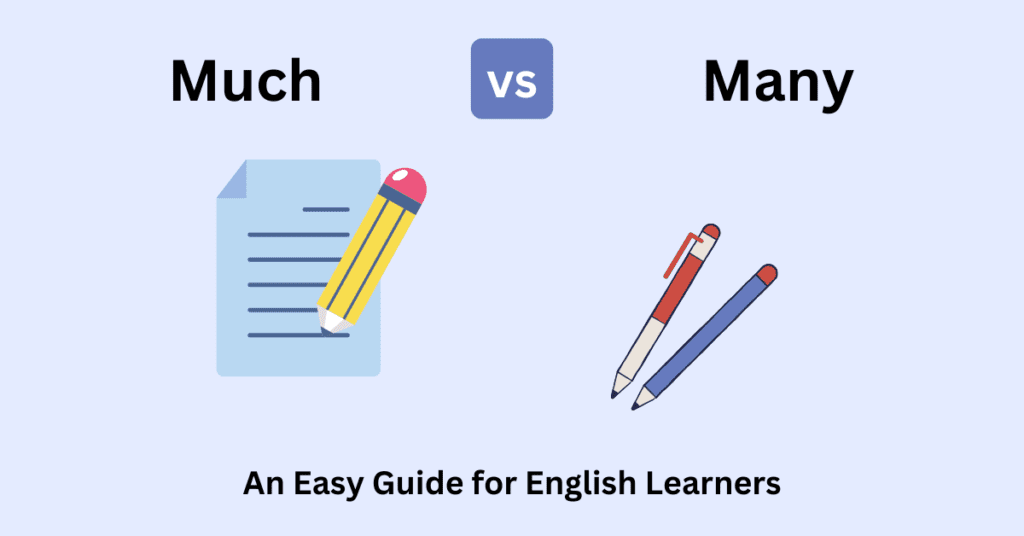
English grammar can sometimes be tricky, especially when it comes to choosing the right words. One common area of confusion is understanding the difference between much and many. Both are quantifiers used to describe amounts, but they are not interchangeable. Knowing “much vs many” and when to use each term correctly is essential for clear and correct communication and writing.
Why is There Confusion?
The confusion between “much and many” arises because both words are used to talk about quantity, but they apply to different types of nouns. While “much” is used with uncountable nouns (things you can’t count individually, like water or sugar), “many” is used with countable nouns (things you can count, like apples or books).
This difference might seem simple, but the challenge often comes from identifying whether a noun is countable or uncountable.
⚡ Quick Summary
The words “much” and “many” both describe quantity, but they are used in different contexts. “Much” is used with uncountable nouns, such as “water” or “time,” while “many” is used with countable nouns, like “books” or “apples.” Both words can appear in negative sentences, questions, and formal expressions, but in positive sentences, they are often replaced by “a lot of”.
Definition of “Much”
“Much” is a quantifier used to indicate a large amount or degree of something. It is specifically applied to uncountable nouns, which refer to things that cannot be counted individually. These include abstract ideas, substances, or mass nouns like water, information, or happiness.
When to Use “Much”?
“Much” is used with uncountable nouns to express a large quantity or degree of something. It is commonly found in negative sentences, questions, and formal expressions. For example:
- Negative sentences: “There isn’t much time left before the deadline.”
- Questions: “How much money do you need for the trip?”
- Formal statements: “Much progress has been made in the project.”
Must Read: Of vs Off : When to Use Each Correctly
Definition of “Many”
“Many” is a quantifier used to indicate a large number of something. It applies specifically to countable nouns, which refer to items or things that can be counted individually, such as books, cars, or people.
When to Use “Many”?
“Many” is used with countable nouns to indicate a large number of items or things. It frequently appears in questions, negative sentences, and formal contexts. For example:
- Questions: “How many books are on the shelf?”
- Negative sentences: “There aren’t many chairs in the room.”
- Formal statements: “Many opportunities await those who work hard.”
Similarities and Differences
Similarities
Despite being used with different types of nouns (uncountable for “much” and countable for “many”), “much” and “many” share several key similarities:
-
Both express quantity: They are used to indicate a large amount or number of something.
- “Much” refers to a large amount of an uncountable noun (e.g., much water, much time).
- “Many” refers to a large number of countable nouns (e.g., many books, many people).
-
Both appear in negative sentences and questions:
- In questions: “How much money do you have?” and “How many apples are there?”
- In negative sentences: “I don’t have much money.” and “There aren’t many cars in the parking lot.”
-
Both can be used in formal contexts: Both “much” and “many” are suitable for formal writing, such as academic papers or reports, when expressing quantity.
Differences Between “Much” and “Many”
While “much” and “many” are both used to express quantity, their main difference lies in the type of nouns they modify:
-
Countable vs. Uncountable Nouns:
- Much is used with uncountable nouns (things that cannot be counted individually), such as water, sugar, time, or money.
- Example: “There isn’t much water left in the bottle.”
- Many is used with countable nouns (things that can be counted individually), such as books, cars, or people.
- Example: “There are many books on the shelf.”
- Much is used with uncountable nouns (things that cannot be counted individually), such as water, sugar, time, or money.
-
Usage in Positive Sentences:
- In positive sentences, “much” is less common and often replaced by “a lot of” for a more natural tone, especially with uncountable nouns.
- Example (formal): “I have much work to do.”
- Example (informal): “I have a lot of work to do.”
- Many, however, is more commonly used in positive statements without needing replacement.
- Example: “I have many things to do.”
- In positive sentences, “much” is less common and often replaced by “a lot of” for a more natural tone, especially with uncountable nouns.
-
Frequency of Use:
- Much is more frequently used in negative sentences and questions.
- Example (negative): “There isn’t much time left.”
- Example (question): “How much money do you have?”
- Many is more often used in negative sentences and questions as well, but it is considered more natural in positive contexts than “much.”
- Example (negative): “There aren’t many people here.”
- Example (question): “How many friends do you have?”
- Much is more frequently used in negative sentences and questions.
Nouns That Often Confuse: Should You Use “Much” or “Many”?
| Noun | Countable/Uncountable | Use with |
|---|---|---|
| Advice | Uncountable | Much |
| Equipment | Uncountable | Much |
| Furniture | Uncountable | Much |
| Homework | Uncountable | Much |
| Information | Uncountable | Much |
| Money | Uncountable | Much |
| News | Uncountable | Much |
| Books | Countable | Many |
| Children | Countable | Many |
| People | Countable | Many |
The Usage of “Much” in Different Contexts
-
Negative Sentences:
- “There isn’t much water left in the bottle.”
- “I don’t have much time to spare.”
-
Questions:
- “How much sugar do you need for the recipe?”
- “Is there much noise in the room?”
-
Formal Statements:
- “Much effort has been made to complete this project.”
- “He doesn’t show much interest in sports.”
-
Expressions:
- “Thank you so much for your help!”
- “She earns much less than her colleagues.”
The Usage of “Many” in Different Contexts
-
Negative Sentences:
- “There aren’t many chairs in the room.”
- “I don’t have many friends in this city.”
-
Questions:
- “How many apples do you want?”
- “Are there many students in the class?”
-
Positive Sentences:
- “Many people attended the event.”
- “She has written many books on the subject.”
-
Expressions:
- “As many as 100 participants joined the competition.”
- “For many years, he worked as a teacher.”
You’ll Like: Than vs Then: Avoiding Common Mistakes in English
Etymology of “Much” and “Many”
Etymology of “Much”
The word “much” dates back to the 12th century, evolving from Middle English muchel (“large, great in amount”) and Old English micel, rooted in the Proto-Germanic *mekilaz and Proto-Indo-European *meg- (“great”). Initially meaning “large quantity” or “extent,” it later narrowed to signify quantity or degree with uncountable nouns.
As an adverb, “much” has formed compound adjectives (e.g., “much-loved”) since the 17th century. Expressions like “too much” appeared in the 14th century, meaning “astonishing” or “excessive,” later gaining informal uses like “excellent” in the 20th century.
Etymology of “Many”
The word “many” originates from Middle English mani or manige, derived from Old English monig, meaning “numerous” or “a large number.” Its roots trace back to the Proto-Germanic *managaz, with related terms found in various languages, such as Old Saxon manag and Gothic manags, possibly from the Proto-Indo-European *menegh-, meaning “copious” or “frequent.”
The pronunciation of “many” was influenced by the word “any”, leading to its modern form. Historically, Middle English featured comparative forms like manier and maniest, as well as adverbial uses like manygates (“in many ways”). As a noun, “many” referred to a “large number” or “multitude,” with phrases like “the many” emerging in the 16th century to describe the general masses.
Conclusion
Understanding the difference between “much” and “many” is essential for clear and accurate communication in English. Both words signify quantity, but their usage depends on whether the noun is countable or uncountable. While “much” is reserved for uncountable nouns, “many” is used with countable ones.
Sources
Etymonline (Etymology of much by etymonline) and Etymonline (Etymology of many by etymonline).