
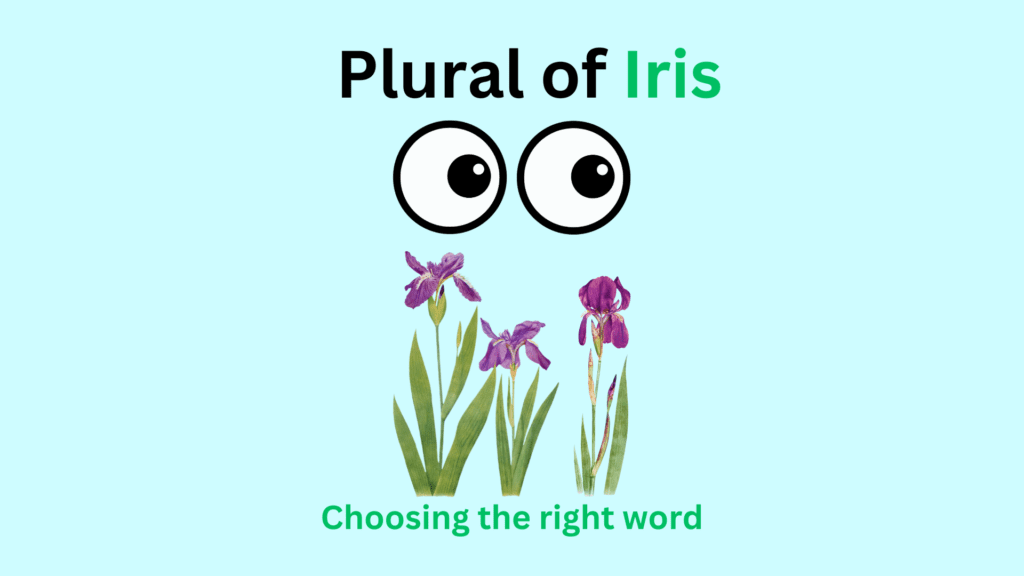
Ever wondered what is the plural of “iris”? Well, you can say it in two ways: “irises” or “irides”! In this article, we’ll break it down with simple examples.
What is the Plural of Iris?
The plural of “Iris” can be expressed in two ways: “irises” or “irides.” Both forms are accepted, but “irises” is more commonly used. These terms refer to multiple instances of the flower genus Iris or the anatomical structure within the eye.
Why Are the Plurals ‘Irises’ and ‘Irides’?
The variation in plural forms for “Iris” is also influenced by its origin and usage context. While English typically follows consistent pluralization rules, the origin of words can sometimes affect their plural forms. “Iris” derives from Greek, where “irides” is the plural form. In English, when borrowing words from other languages, plural forms might retain their original language’s rules. Hence, both “irises” (following English pluralization rules) and “irides” (reflecting the Greek origin) are accepted.
You will like: Plural of Calculus
What is an Iris?
An iris can refer to either a flowering plant or a part of the eye. In the botanical sense, an iris is a genus of plants known for its showy, colorful flowers. These flowers typically have six petal-like segments, including three upright petals (standards) and three hanging petals (falls). Irises come in various colors and are commonly cultivated for their ornamental beauty.
On the other hand, in anatomy, the iris is a thin, circular structure within the eye that surrounds the pupil. It controls the amount of light entering the eye by adjusting the size of the pupil. The color of the iris is what gives eyes their distinct shades, such as blue, brown, or green.
Using ‘Iris’ in Sentences (Singular Usage)
- In the florist shop, a stunning iris caught my eye with its delicate blue petals.
- The artist painted a solitary iris on the canvas, focusing on its intricate details.
- As she strolled through the botanical garden, she admired the diversity of irises in various colors.
- The photographer captured the unique texture of the iris as it opened to reveal its vibrant center.
- The poet found inspiration in the solitary beauty of an iris swaying in the breeze.
- During the biology class, the teacher explained the role of the iris in regulating light within the eye.
- A single drop of dew glistened on the petal of the morning iris, reflecting the rising sun.
- With a magnifying glass, the scientist examined the cellular structure of the iris under the microscope.
- In the enchanting garden, a burst of color unfolded as the white lilies gracefully accompanied a deep purple iris in full bloom.
- The old man reminisced about planting his first iris decades ago, a tradition he continued to this day.
Using ‘Irises’ and ‘Irides’ in Sentences (Plural Usage)
Usage of “Irises”:
- In her backyard, various irises flourished, turning the garden into a kaleidoscope of colors.
- The florist arranged a bouquet featuring irises of different shades, from delicate blues to vibrant yellows.
- During spring, the hillsides were dotted with wild irises, creating a picturesque scene.
- Gardening enthusiasts gathered to exchange tips on cultivating irises, sharing their favorite varieties.
- She took pride in her collection of irises, carefully tending to each one for optimal bloom.
- The botanical exhibit showcased rare and exotic irises, drawing visitors from near and far.
- Children delighted in the vibrant irises, eagerly identifying the various colors and patterns.
- The iris competition featured stunning entries, with judges evaluating the uniqueness of each bloom.
- The landscape transformed as irises blanketed the fields, signaling the arrival of spring.
- Artists found inspiration in the beauty of irises, capturing their essence on canvases of various sizes.
Usage of “Irides”:
- The geneticist studied the irides of a diverse group, aiming to unravel the mysteries of eye color inheritance.
- His family marveled at the array of irides present in their photo album, showcasing the diversity across generations.
- The scientific conference featured presentations on the evolution of irides among different species.
- Researchers conducted a study comparing the irides of identical twins, exploring the role of genetics in eye color.
- In the photography exhibit, portraits highlighted the uniqueness of individuals through their captivating irides.
- A crowd gathered to witness the unveiling of a mural, capturing the community’s collective irides.
- The optometrist explained the factors influencing changes in irides over time during the eye care seminar.
- Iridescent contact lenses gained popularity, allowing wearers to experiment with different eye colors.
- Anthropologists discovered ancient artifacts adorned with depictions of mythical creatures with iridescent irides.
- The wildlife documentary showcased the mesmerizing beauty of animals with iridescent irides, captivating viewers worldwide.
You will like: Plural of oasis
Origins of the word ‘Iris’
The word ‘Iris’ finds its roots in Latin, where it originally referred to the iris of the eye, the thin, colored disk that controls the size of the pupil. Over time, its usage expanded to encompass the iris flower, known for its vivid and diverse colors. The Latin language borrowed the term from Greek, and it eventually found its way into English. So, while Latin plays a significant role in the word’s journey, it also carries a connection to Greek.
Conclusion
In simple terms, the plural of “iris” is either “irises” or “irides.” When talking about the colorful flowers in a garden, “irises” is commonly used. However, when referring to the part of the eye that controls light, both “irises” and “irides” are acceptable.
The reason we have two plurals is because “iris” has roots in both Latin and Greek. English likes to keep things interesting like that! So, next time you’re talking about a bunch of flowers or chatting about eyes, you know you have options for the plural form of “iris.”
Sources
Merriam-Webster, Wikipedia (Iris Plant) and Wikipedia (Iris Anatomy).


