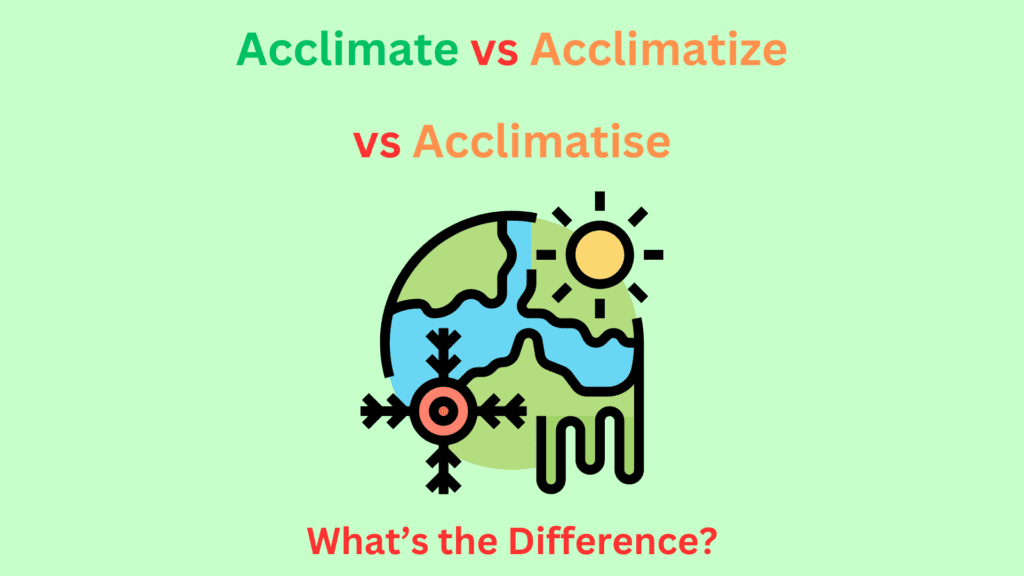
In this article, we’ll take a closer look at ‘acclimate’ vs ‘acclimatize’ vs ‘acclimatise.’ These verbs may sound alike but have distinct meanings and regional variations. By understanding these differences, you’ll gain clarity on when to use each verb correctly in various situations.
What do “Acclimate”, “Acclimatize” and “Acclimatise” Mean?
Acclimate
“Acclimate” refers to the process of gradually becoming accustomed to a new climate, environment, or conditions. It involves adapting to changes in temperature, humidity, or other environmental factors. For example, when someone moves from a cold climate to a warmer one, they may need time to acclimate to the higher temperatures. Similarly, plants and animals may undergo a period of acclimation when introduced to new habitats.
Acclimatize
“Acclimatize” is commonly used in contexts related to physiological adaptation to environmental changes, such as altitude or pressure. It refers to the process of adjusting to changes in altitude, pressure, or other physical conditions. For instance, climbers need to acclimatize to higher altitudes to avoid altitude sickness. Additionally, individuals traveling to high-altitude regions may need to acclimatize their bodies to the reduced oxygen levels.
Acclimatise
Acclimatise” is the British English spelling of “acclimatize,” and they are essentially the same words with different spellings based on regional variations. Both “acclimatize” (used in American English) and “acclimatise” (used in British English) refer to the process of adjusting to new environmental conditions, particularly concerning altitude, pressure, or climate changes. They both imply a deliberate effort to adapt physiologically to specific challenges, such as preparing for higher altitudes or coping with different climates. The choice between “acclimatize” and “acclimatise” typically depends on the preferred spelling conventions of the English dialect being used, with “acclimatize” being more common in American English and “acclimatise” being more common in British English. Despite the spelling difference, both terms carry the same meaning and usage.
Acclimate vs Acclimatize vs Acclimatise: What are the Differences
When differentiating between “acclimate,” “acclimatize,” and “acclimatise,” it’s important to note not only their meanings but also their prevalence in different English-speaking regions. In American English, “acclimate” is more commonly used to describe the process of adjusting to new environmental conditions, while “acclimatize” is also understood but less frequently used. On the other hand, in British English, “acclimatise” is the preferred spelling and usage, aligning more closely with its usage in Commonwealth countries.
“Acclimate” typically describes a gradual adaptation to changes in climate or environment, suggesting a passive adjustment over time. For instance, individuals might acclimate to warmer temperatures after moving from colder regions, or plants may acclimate to different soil conditions.
Both “acclimatize” and “acclimatise” imply a deliberate effort to adapt physiologically to specific challenges, such as altitude or pressure changes. Climbers, for example, need to acclimatize or acclimatise to higher altitudes to mitigate altitude sickness, a process involving gradual exposure to increasing elevations to allow the body to adapt.
A Simple Table for Acclimate vs Acclimatize vs Acclimatise
| Aspect | Acclimate | Acclimatize (American English) | Acclimatise (British English) |
|---|---|---|---|
| Definition | Process of gradually adapting to new climate, environment, or conditions | Process of adjusting to new environmental conditions, particularly altitude, pressure, or climate changes | Process of adjusting to new environmental conditions, particularly altitude, pressure, or climate changes |
| Implication | Natural, passive adjustment | Deliberate, purposeful adaptation | Deliberate, purposeful adaptation |
| Scope | Broad environmental changes | Specific challenges like altitude or pressure changes | Specific challenges like altitude or pressure changes |
| Usage | Common in American English | Common in American English | Common in British English |
You will like: Excel or Accel: What is the correct Spelling?
Origins of These Verbs
Acclimate
The word “acclimate” originated from the Latin word “acclimatare,” which means “to accustom to climate.” The Latin word is a combination of “ad” (meaning “to”) and “climatare” (meaning “to climb” or “to slope”). Over time, “acclimate” evolved in English to encompass a broader meaning of adapting to various environmental conditions.
Acclimatize
“Acclimatize” shares a similar origin with “acclimate.” It also derives from the Latin word “acclimatare.” The addition of the suffix “-ize” in English comes from Greek origins, where “-izein” was used to form verbs indicating action or process. Therefore, “acclimatize” signifies the process of adapting to new environmental conditions.
Acclimatise
“Acclimatise” follows the same etymological path as “acclimatize.” However, the spelling “acclimatise” is the British English variant, following British spelling conventions. The “-ise” ending is common in British English, influenced by French spellings, while American English tends to use “-ize” endings, influenced by Greek spellings.
You will like: Traveler or Traveller: Which Spelling is Right?
A Simple Tense Table of these Verbs
| Tense | Acclimate | Acclimatize | Acclimatise |
|---|---|---|---|
| Simple Present | acclimate | acclimatizes | acclimatises |
| Simple Past | acclimated | acclimatized | acclimatised |
| Present Continuous | am/is/are acclimating | am/is/are acclimatizing | am/is/are acclimatising |
| Past Continuous | was/were acclimating | was/were acclimatizing | was/were acclimatising |
| Present Perfect | have/has acclimated | have/has acclimatized | have/has acclimatised |
| Past Perfect | had acclimated | had acclimatized | had acclimatised |
| Present Perfect Continuous | have/has been acclimating | have/has been acclimatizing | have/has been acclimatising |
| Past Perfect Continuous | had been acclimating | had been acclimatizing | had been acclimatising |
Examples in Context
Acclimate:
- Simple Present: She acclimates quickly to the hot weather every summer.
- Present Continuous: They are acclimating to the new office environment this week.
- Simple Past: He acclimated to the high altitude during his mountain expedition last year.
- Past Continuous: While traveling, we were acclimating to different time zones every few days.
- Present Perfect: The plants have acclimated well to the greenhouse conditions.
- Past Perfect: By the time we arrived, the team had already acclimated to the local customs.
- Future Simple: Tomorrow, I will acclimate myself to the new workout routine.
- Future Perfect: By next month, she will have acclimated to her new role at the company.
Acclimatize (American English):
- Simple Present: The climbers acclimatize by spending several days at base camp before ascending.
- Present Continuous: We are currently acclimatizing to the higher altitude.
- Simple Past: He successfully acclimatized to the lower oxygen levels during his trek.
- Past Continuous: While on the expedition, they were acclimatizing to the extreme weather conditions.
- Present Perfect: The athletes have acclimatized to the intense training regimen.
- Past Perfect: By the time of the competition, the team had already acclimatized to the stadium’s atmosphere.
- Future Simple: Next week, they will acclimatize to the new equipment.
- Future Perfect: By the time you return, I will have acclimatized to the changes in the project.
Acclimatise (British English):
- Simple Present: People often acclimatise gradually to changes in temperature.
- Present Continuous: The team is acclimatising to the colder climate this season.
- Simple Past: She acclimatised quickly to the different culture when she moved abroad.
- Past Continuous: While studying abroad, they were acclimatising to the local customs and language.
- Present Perfect: The birds have acclimatised well to their new habitat.
- Past Perfect: By the time we visited, they had already acclimatised to the higher altitude.
- Future Simple: Next month, they will acclimatise to the new office layout.
- Future Perfect: By the time you arrive, I will have acclimatised to the changes in schedule
You will like: Illicit vs Elicit: What is the Difference?
Synonyms
Acclimate
- Adapt
- Adjust
- Accommodate
- Familiarize
- Get used to
Acclimatize (American English)
- Adapt
- Adjust
- Accustom
- Condition
- Harden
Acclimatise (British English)
- Adapt
- Adjust
- Accustom
- Habituate
- Inure
You will like: Center vs Centre
A Final look on Acclimate vs Acclimatize vs Acclimatise
In conclusion, while “acclimate,” “acclimatize,” and “acclimatise” all involve adapting to new environments, their usage may vary based on regional language preferences. American English favors “acclimatize,” British English leans towards “acclimatise,” while “acclimate” is recognized across both dialects but less commonly used outside of American English. Despite these differences, each verb conveys the essential concept of adjusting and familiarizing oneself with changes in surroundings.
Sources
Merriam-Webster (Acclimate Definition & Meaning), Thesaurus.com (12 Synonyms & Antonyms for acclimate), Dictionary.com (ACCLIMATIZE Definition & Usage Examples), Wikipedia (acclimatize – Wiktionary, the free dictionary), Cambridge Dictionary (ACCLIMATIZE – 42 Synonyms and Antonyms) and Vocabulary.com (Acclimatise – Definition, Meaning & Synonyms).