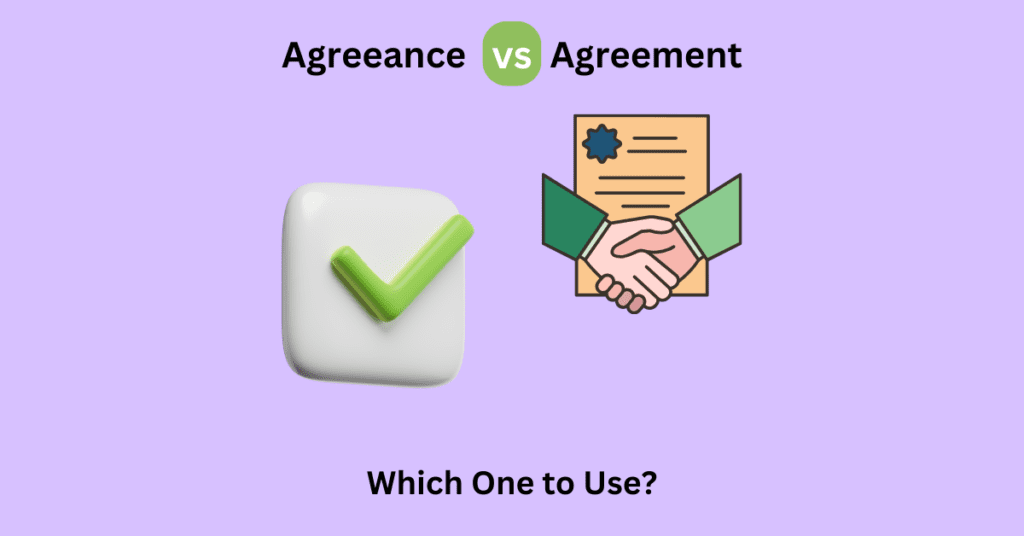
When we talk, sometimes we use different words that seem similar but have their own meanings. That’s the case with “agreeance” and “agreement.” They might seem the same, but they’re not quite. Let’s take a look at agreeance vs agreement, so we know which one to use when we’re talking or writing.
What do they Mean?
They both relate to the idea of coming together in thought or action, but with a subtle difference:
Agreeance
Agreeance is less common and more informal. It describes the state of being in agreement. It’s not wrong, but it can sound a bit old-fashioned or even pretentious.
Agreement
Agreement is the more common and formal term. It refers to a mutual understanding or decision reached by two or more parties. This could be anything from a casual “Yes, that sounds good” to a signed contract.
Here’s an Analogy: Think of agreement as the handshake, the formal action, and agreeance as the feeling of satisfaction or harmony that comes from shaking hands.
In most cases, “agreement” is the better choice. It’s clearer, more common, and works well in both formal and informal settings.
Must Read: Connector or Connecter: What’s the Correct Spelling?
“Agreeance” or “Agreement”: Which One Should Be Used?
You should almost always use agreement. Here’s why:
- Agreement is the widely accepted and standard term. It’s straightforward, brief, and gets the point across to everyone.
- Agreeance is uncommon and can sound awkward or even pretentious in most contexts.
While technically not wrong, agreeance might cause a raised eyebrow in formal settings like business writing or legal documents.
Here’s a quick guideline:
- Use agreement for any situation where you want clear and professional communication.
- Agreeance might be appropriate in very casual speech or very specific writing styles, but even then, agreement is a safer bet.
Agreeance vs Agreement:
| Feature | Agreeance | Agreement |
|---|---|---|
| Definition | The state of being in agreement | A mutual understanding or decision reached by two or more parties |
| Formality | Informal | Formal and Informal |
| Commonality | Less common | Widely accepted and standard term |
| Clarity | Less clear, can be confused with simply being agreeable | Clear and specific |
| Best Usage | – Very casual speech – Specific writing styles (rare) | – Most situations – Formal writing (contracts, business documents) <br> – Informal settings |
| Analogy | The feeling of satisfaction or harmony after a handshake | The handshake itself, sealing a deal |
| Example Sentence | “There was a general agreeance with the plan.” (informal) | “We reached an agreement on the final price.” (formal/informal) |
Which One is More Acceptable?
The use of the word “Agreeance” is increasing very much in modern speaking and writing. But in almost all cases, “agreement” is the more acceptable term.
Here’s why:
Wider Recognition: Agreement is the standard and widely recognized word. Everyone understands it perfectly.
Clarity: Agreement clearly conveys the idea of a shared understanding or decision. Agreeance can be a bit ambiguous and might be confused with simply being agreeable (willing to go along with something).
Formality: Agreement works well in both formal and informal settings. Agreeance leans more towards casual speech.
So, unless you’re aiming for a very specific and informal tone, agreement is the safer and more widely accepted choice.
You will like: Totalling or Totaling: Which Spelling to Use?
Why is There Confusion?
There are a couple of reasons why there might be confusion between agreement and agreeance:
Similarities: Both words share the same root (“agree”) and deal with the concept of coming together in thought or action.
Less Common Usage of Agreeance: Agreeance is a less common word compared to agreement. This can lead to uncertainty about its proper usage.
Subtle Difference in Meaning: While agreement refers to the concrete action or understanding, agreeance focuses on the resulting state of being in agreement. This nuance can be easily missed, especially for non-native speakers.
Breaking Down the Causes of Confusion
Someone might mistake agreeance for a synonym of agreement. Since they both relate to agreeing, someone might use them interchangeably.
Exposure to Less Common Usage: If someone encounters agreeance in a specific context (like a particular writing style), they might wonder if it’s the more appropriate term.
To avoid confusion, it’s best to stick with agreement in most situations. It’s clear, widely understood, and works well in all formality levels.

Using “Agreeance” and “Agreement” in Sentences
Agreeance (Informal)
- There was a general agreeance with the plan to have a potluck for the office party.
- After a long debate, they finally reached an agreeance on the movie to watch.
- There was a sense of agreeance in the room as everyone nodded in approval.
- “I think we have an agreeance here,” she said with a smile.
- Despite their differences, they found some areas of agreeance while discussing politics.
- The siblings argued for a while, but eventually reached a grudging agreeance.
- “There seems to be a general agreeance that the blue paint looks best,” remarked the decorator.
- The team celebrated their agreeance on the project deadline with a round of high fives.
- Despite the language barrier, they managed to find some basic agreeance on their needs.
- “There’s a growing agreeance that climate change is a real threat,” stated the environmental activist.
Agreement (Formal & Informal)
- We reached a formal agreement on the sale price of the house. (Formal)
- They shook hands on their agreement to work together on the project. (Informal)
- The contract outlines the terms of the agreement between the two companies. (Formal)
- “Can we have your agreement on these new meeting times?” asked the manager. (Formal)
- There was a verbal agreement between the friends to help each other move. (Informal)
- The lawyer reviewed the agreement before they signed it. (Formal)
- Both parties came to a peaceful agreement to settle the dispute. (Formal)
- The agreement was clear – they would split the cost of the repairs. (Informal)
- A written agreement is always best to avoid misunderstandings. (Formal)
- They celebrated their agreement with a toast and a handshake. (Informal)
You will like: Is it Pallette or Palette? Choosing the Correct Spelling!
Origins of “Agreeance” and “Agreement” Words
Agreement:
This word has a longer history, dating back to the late Middle English period (around 1375-1425). It comes from the Old French word “agreement,” which itself combines “agree” with the suffix “-ment” signifying the act or state of something. So, agreement inherently carries the meaning of both the action of coming to terms and the resulting state of being aligned.
Agreeance:
This word has a more recent origin, appearing in Scottish English around the early 15th century. It likely formed by adding the suffix “-ance” (denoting a condition or state) to the verb “agree.” Agreeance emphasizes the state of being in agreement, rather than the action itself.
Here’s an Interesting Point:
While “agreeance” is technically correct, it’s considered less standard compared to “agreement” especially in formal contexts. This might be because “agreement” has a longer history and encompasses both the action and the state.
Conclusion
In conclusion, agreeance and agreement both suggest coming together in thought or action. Agreeance is less common and more informal, describes the state of being in agreement. Agreement is widely used term for a mutual understanding or decision, working in both formal and informal settings. Think of agreement as the handshake itself, finalizing the deal, and agreeance as the feeling of satisfaction that follows. For clear communication, “agreement” is your best bet.
So, the next time you need to express a shared understanding, reach for “agreement” – it’s the handshake that seals the deal, not just the feeling of satisfaction afterward.
Sources
Wikipedia (agreeance – Wiktionary, the free dictionary), Oxford English Dictionary (agreeance, n. meanings, etymology and more), Merriam-Webster (Agreement Definition & Meaning) and Etymonline (Etymology of agreement by etymonline).